
Shreeparna Das is a writer and researcher at The Case Hunter, an independent online magazine covering European mysteries, unsolved cases, and folklore. Click here to access her case file on the Hexham Heads.
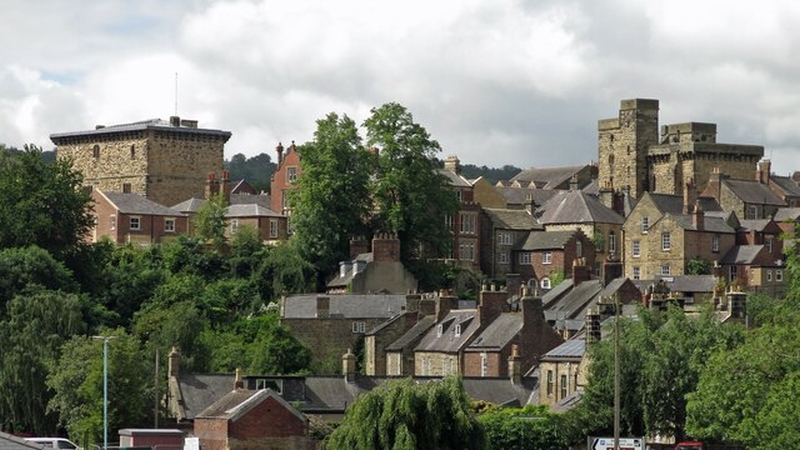
Image Source: Wikimedia Commons
Hexham does not look like a town with a werewolf problem. It sits on a rise above the River Tyne, about twenty miles west of Newcastle, England. It boasts a marketplace, a medieval abbey, a park called the Sele where people walk dogs, and a railway station that has been receiving trains since 1835. It’s the kind of place guidebooks call handsome. And yet, in 1971, something was dug out of a garden here that frightened two families, divided Britain’s archaeologists, and followed a Celtic scholar three hundred miles south to her own bedroom door.
This is a walk through Hexham’s strange side, from that garden to the oldest purpose-built prison in England, with notes on how to see it for yourself.
Rede Avenue: The Garden
Start on the northern edge of town, in a quiet council estate of semi-detached houses. In early 1971, two brothers, Colin and Leslie Robson, were digging in their back garden on Rede Avenue when they turned up a small carved stone head, roughly the size of a tennis ball, with a crude face worked into it. Then they found a second. One had a skull-like face and came to be called the “boy”; the other, with wilder features and what looked like a bun of hair, was the “girl”. The boys took them indoors.
What followed was reported by the family and then, more seriously, by the neighbours. The heads would be found turned to face a different way. Objects broke. Next door, Ellen Dodd was sitting up one night with a sick child when a creature came into the room, half man and half animal, sheep-like or wolf-like depending on the retelling, which brushed past her legs and padded out. The front door was later found open. The Dodds moved out.

The heads went to Dr Anne Ross, one of the country’s leading authorities on the Iron Age Celts, at her home in Southampton. Ross concluded they were probably ancient and linked to the Celtic cult of the severed head, a well-attested tradition in this part of Britain. Then she, and independently her teenage daughter, saw a tall figure, half man and half wolf, in the house, moving with a soft padding gait. Ross eventually removed every carved head she owned from the building.
And then a lorry driver named Desmond Craigie, who had lived in the Rede Avenue house before the Robsons, announced that he had made the heads himself around 1956 as toys for his daughter, and made another to prove it. Analysis of the stone was argued over rather than settled. The heads passed through several hands and then simply vanished. Nobody can produce them today.
Visiting note: Rede Avenue is an ordinary residential street and the houses are private homes. There’s nothing to see beyond the street itself, and the people living there did not sign up for ghost tourism. If you go, walk the street, keep your camera on the pavement, and don’t knock on doors. The real value is in standing in a very ordinary place and knowing what came out of it.
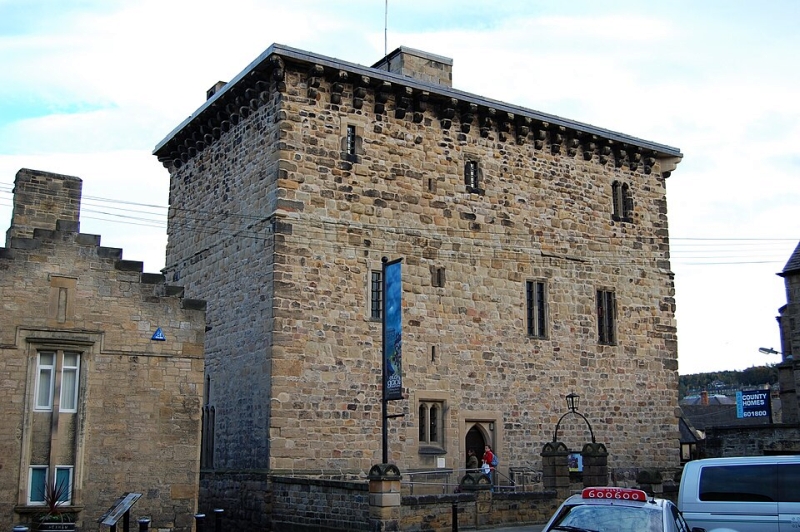
Image Source: Wikimedia Commons
Hexham Old Gaol: Seven Centuries of Prisoners
Walk back into the centre, past the Market Place, and you come to a squat stone tower on Hallgate. This is Hexham Old Gaol, built between 1330 and 1333 for the Archbishop of York, who ruled Hexhamshire as his own little territory. It’s generally accepted as the earliest purpose-built prison in England, and it did its job for nearly five hundred years, until 1824.
It’s now a museum, and a good one. A glass lift takes you down through the floors to the dungeon, a stone pit where the poorest prisoners were kept and where, by the accounts of the time, they depended on charity or their families for food. The upper floors tell the story of the Border Reivers, the raiding families who made the Anglo-Scottish frontier one of the most lawless places in Europe for three centuries, and whose surnames (Armstrong, Charlton, Robson, Milburn) are still all over Northumberland.
Old prisons collect ghost stories the way old churches collect pigeons, and the Gaol is no exception. Staff and visitors have reported sudden cold in the dungeon level, the sense of being watched on the stairs, and figures glimpsed where no one is standing. The museum does not lean on any of this; the building’s real weight is in the stones themselves and in the knowledge that people were held here, in the dark, for seven hundred years.
Visiting note: The Gaol is a short walk from the Abbey and the Market Place. It normally opens from spring to autumn with limited winter hours, so check the current times before you travel. Allow an hour.
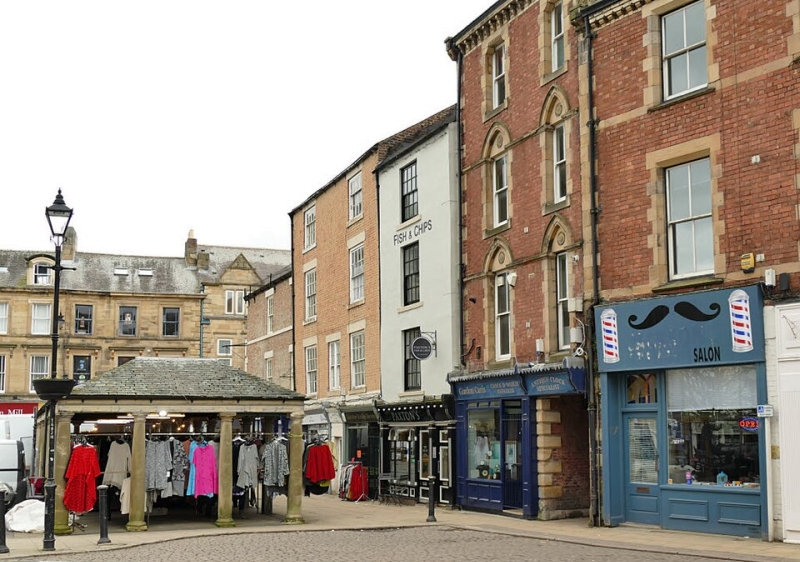
Image Source: Wikimedia Commons
The Market Place: Bloody Monday
Between the Gaol and the Abbey is the Market Place, with its 18th-century Shambles, a covered market of stone columns. It’s a pleasant place to sit with a coffee. On 9 March 1761 it was the scene of one of the worst civilian massacres in English history.
The cause was the militia ballot, a form of conscription that fell hardest on working men who could not afford to pay a substitute. Several thousand people, many of them lead miners and keelmen from the surrounding valleys, gathered in Hexham to protest. Magistrates read the Riot Act. The North Yorkshire Militia, drawn up in the Marketplace, opened fire. The usual figure given is around fifty dead, with many more wounded, and the day is still remembered locally as Bloody Monday. There is no monument. If you stand in the Market Place with your back to the Abbey, you’re standing roughly where the crowd was.
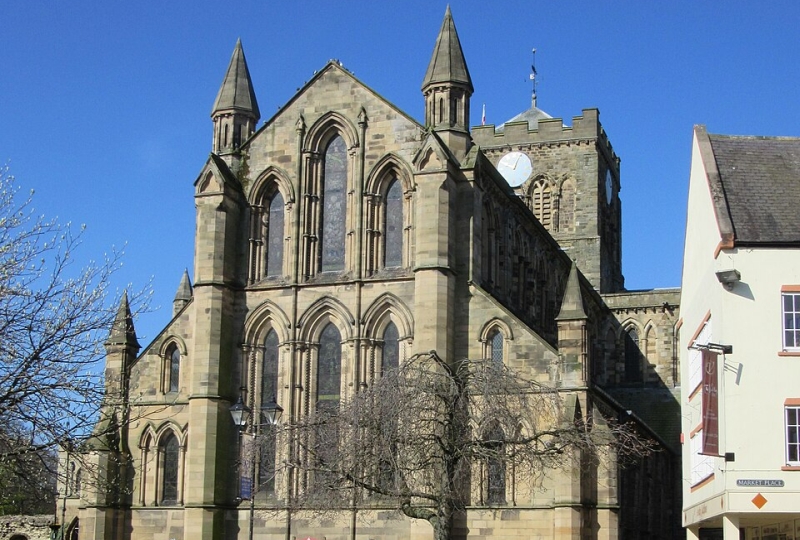
Image Source: Wikimedia Commons
Hexham Abbey: The Crypt Made of Roman Stones
The Abbey dominates the west side of the Market Place. Wilfrid, Bishop of York, founded it in AD 674, and to build it his masons went to the abandoned Roman town of Coria, at Corbridge four miles east, and carted the stones away. The result survives beneath the present church: a Saxon crypt, one of the finest in Europe, whose walls are made of reused Roman blocks, some of them still carrying Roman inscriptions and carvings.
Go down into the crypt. It’s small, low and cold, lit dimly, and more than 1,300 years old. Relics were once displayed here for pilgrims who filed through in one door and out another.
Back in the nave, look for the tombstone of Flavinus, a Roman standard-bearer who died at about twenty-five. The stone shows him on horseback riding down a crouching, bearded Briton, and it was found under the floor of the Abbey in 1881, having spent centuries as a building block. Nearby is the Frith Stool, a stone chair that may date from Wilfrid’s own time and which once marked the limit of sanctuary: reach it, and the law could not touch you.
The Abbey has the ghost stories you would expect of a church this old. Visitors and guides have described a robed figure on the night stair (the broad stone staircase the canons used to come down from their dormitory for services) and the feeling of company in the crypt.
Visiting note: The Abbey is open daily and entry is free, though donations are asked for. The crypt is sometimes closed for services or events, so ask at the desk when you arrive. The Sele, the park beside the Abbey, is a good place to sit afterwards.
Putting It Together: A Half-Day Route
Getting there. Hexham is on the Tyne Valley railway line between Newcastle and Carlisle. Trains from Newcastle take around forty minutes and run roughly hourly. From the station, the town centre is a ten-minute uphill walk. By road, Hexham is just off the A69.
Morning. Start at the station and walk up into town. Go to the Old Gaol first while it’s quiet, then cross to the Market Place and the Shambles.
Midday. The Abbey and its crypt. Eat in the Market Place; there are plenty of cafés.
Afternoon. Walk to Rede Avenue (about fifteen minutes north of the centre) for the Hexham Heads street, respectfully, then loop back through the Sele. If you have a car and the day is long, the Roman site at Corbridge, where the Abbey’s stones came from, is a short drive east, and Hadrian’s Wall is twenty minutes north.
Time needed. Four to five hours for everything above; a full day if you add Corbridge or the Wall.
Hexham’s strangeness is not the theatrical kind. It’s a market town where the oldest prison in England shares a street with a church built from looted Roman stones, where a massacre left no monument, and where, in spring 1971, two boys dug up something in a vegetable patch that nobody has been able to explain, or find, since.
Leave a Reply