By Greg Mansfield
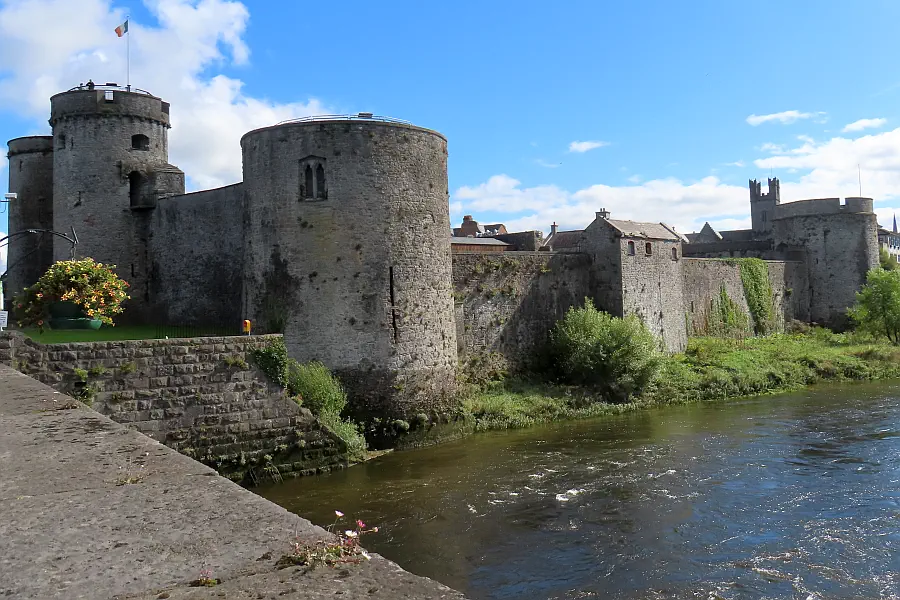
Image by Carolyn Mansfield
Also known as The Shannon Region, Mid-West Ireland is a stunning area that draws tourists to its famous landmarks. These include the towering Cliffs of Moher, the lively music scene in County Clare, and the historic sites and rich cultural life of County Limerick.
Beyond the natural beauty and cultural attractions, however, this region has a spooky side that comes from its medieval past. Scattered across this land are four famous castles. Each one is a witness to centuries of history and a must-see for anyone interested in haunted places. Let’s drop in and meet their phantoms.
Haunted Places in Mid-West Ireland
Bunratty Castle
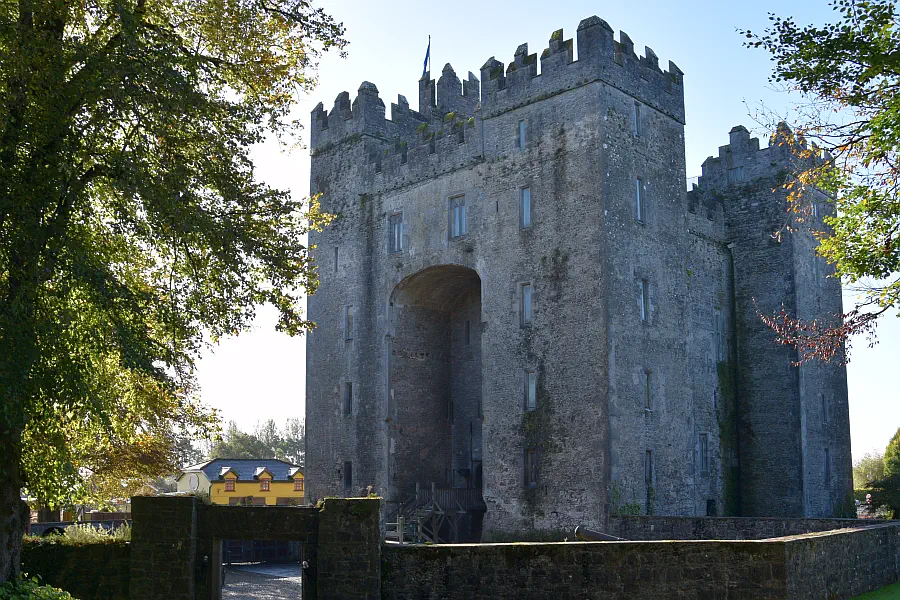
Image by Greg Mansfield
Location: Bunratty East, Bunratty, County Clare
Open: Daily, 9:00am to 5:30pm
Admission Fee: Yes
Parking: Free parking lot across the road
Website: bunrattycastle.ie
Castles built by the Irish typically had massive square, stone towers (tower houses) that rose several storeys high. Bunratty Castle is one of these fortresses. It stands like a brooding giant near the Owenogarney River, and its Irish name, Caisleán Bhun Raithe, means “castle of the Ratty River.” Today, visitors come here for the folk park and medieval feasts held in the castle’s banqueting hall. But many come hoping to encounter its ghosts.
The tower we see today is actually the fourth castle built on this spot. The first signs of settlement here go back to around 977, when it was possibly a Norse trading camp. Then around 1250, a Norman lord named Robert De Muscegros built a wooden fortress here.
The next version didn’t fare well. Thomas De Clare constructed a stone castle, but after he died in battle at Dysert O’Dea in 1318, his widow did something drastic. She fled—but not before setting fire to both the castle and the entire town around it.
The current tower house went up around 1450. It was built by the Irish, probably the MacNamara family. Soon after, the powerful O’Brien clan took control. They ruled North Munster and would later become the Earls of Thomond. The castle weathered many sieges, including a brutal one during the Confederate Wars in 1646.
By the 1700s, the Studdert family owned the place. But around 1804, they moved into the newer, more comfortable Bunratty House nearby. The medieval castle fell into ruins and stayed that way for over 150 years. Finally, in 1956, the 7th Viscount Gort bought the crumbling fortress and restored it. Four years later, he opened it to visitors.

Image by Greg Mansfield
With so much blood and fire in its past, it’s no wonder Bunratty Castle earned a reputation for supernatural activity. The most famous ghost is the Bunratty Banshee.
The story of the banshee dates to 1642. A woman named Lady Fanshawe was staying at the castle when a terrible scream jolted her awake. She looked out her upper-story window and saw something impossible: a young woman with red hair, floating in midair, her face twisted in anguish.
The next morning brought grim news. One of her host family’s cousins—a member of the O’Brien clan—had died during the night. Lady Fanshawe realized she’d seen a banshee, the traditional Irish messenger of death.
The banshee isn’t alone. Another guest once spotted a woman in a Victorian nightgown standing by a window, holding a lit candle. The moment the guest spoke to her, the figure vanished. But the smell remained—the distinct scent of a wax candle that had just been blown out.
Modern visitors report strange experiences too. In 2002, someone standing near the ground-floor doorway felt a sudden rush of energy charge straight at them. Twenty-two years later, in 2024, another guest had an even more unsettling encounter. Something shoved them hard from behind in the banqueting room. Then it happened again near one of the tower staircases.
A few people have heard a phantom dog scratching and whining at a door on an upper floor—a door that leads nowhere. And there’s a darker tale about two Norman knights whose spirits supposedly chased a skeptic through the castle to the point of giving him a heart attack.
Today, Bunratty Castle & Folk Park provides a journey through Irish history. The folk park showcases recreated 19th-century village life. The entire attraction is a popular destination that my wife and I enjoyed visiting very much. Meeting the huge but gentle Irish wolfhounds that live on site was a particular treat!
Bunratty Castle’s stone walls have absorbed centuries of human drama. They’ve witnessed warfare, family tragedies, and grand celebrations. Maybe it’s not so strange that some of that energy lingers.
Dromoland Castle
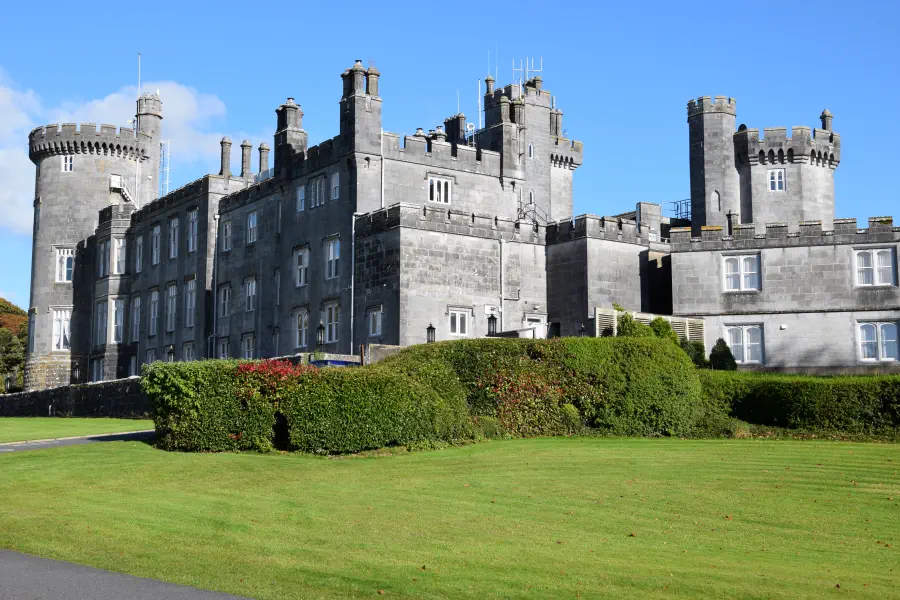
Image by Greg Mansfield
Location: Dromoland, Newmarket on Fergus, County Clare
Open: Daily
Admission Fee: No, it’s a hotel
Parking: Free parking lot
Website: dromoland.ie
Dromoland Castle rises from the Irish landscape like something out of a romance novel. The name comes from the Irish “Drom Ólainn,” which translates to “Hill of Litigation”. Today, it’s known as one of Ireland’s most elegant five-star hotels. But behind its towers the castle hides a few phantoms.
Dromoland Castle originally belonged to one of Ireland’s most storied families—the O’Briens, who hold the title of Barons of Inchiquin. They’re one of the few native Gaelic families who can trace their roots directly back to Brian Boru, Ireland’s High King in the 11th century.
Dromoland’s story began in 1014, when Brian Boru defeated the Danes in battle. After this victory, the O’Briens made their home in the region known as Thomond. Brian Boru’s son, Donough O’Brien, built the first structure on this site. he laid the foundation for what would become a family legacy spanning nearly a thousand years.
The castle we see today is very different from the earlier building. In 1835, after years of construction, the current structure was completed. Architects James and George Richard Pain designed the imposing Gothic Revival building, using dark blue limestone that gives the castle its distinctive, dramatic appearance.
The castle also played a role in Ireland’s fight for independence. William Smith O’Brien was born here in 1803. Decades later, he would lead the Young Irelanders rebellion against British rule in 1848. His story is just one chapter in the castle’s connection to Irish resistance and pride.
The O’Brien family maintained ownership of Dromoland for centuries. Then, in 1962, they sold the estate to Bernard McDonough, an American businessman. He transformed the ancestral home into the luxury hotel.
With nearly a thousand years of history, it’s no surprise that Dromoland has collected a few permanent residents. The most famous is known as the “Lady in the Dark Blue Gown.” Guests and staff describe her as a woman in her 50s with dark, wavy hair. She appears most often on the grand staircase, gliding down the steps as if she’s heading to an elegant dinner party. She moves with grace and purpose, dressed in her distinctive dark blue gown.
No one knows for sure who the Lady in Blue is. One theory suggests she was a 19th-century resident who loved Dromoland so much that her spirit couldn’t bear to leave. Another, darker story claims she was a woman executed for witchcraft, her ghost forever bound to walk the stairs as punishment.
The Lady in Blue isn’t the only supernatural resident of Dromoland. In the 1990s, one hotel guest had an experience she’ll never forget. While staying in a suite in the lower section of the castle, she heard a loud, pitiful moan right next to her ear. The sound was so close and so real that it terrified her. Days later, she learned that a family member had died around the same time. She came to believe she had heard a banshee—a spirit from Irish folklore known for crying out before a death in the family.
Other visitors report their own encounters. Some hear footsteps in empty hallways. Others catch the sound of faint voices when no one else is around. Several guests have felt sudden cold spots or the sensation of being touched by invisible hands. The stairwells seem particularly active, along with the old stables and the area near the main gates.
Dromoland Castle offers its guests world-class service, beautiful rooms, a spa, and a spectacular golf course. If you stop by for a short visit, simply tell the greeter at the front gate that you’re there to look around. You’ll then be welcome to explore the hotel and enjoy the cocktail bar, tea room, or one of its delightful restaurants. Either way, you might end up having a cup of tea or a cocktail with one of its ghosts.
King John’s Castle
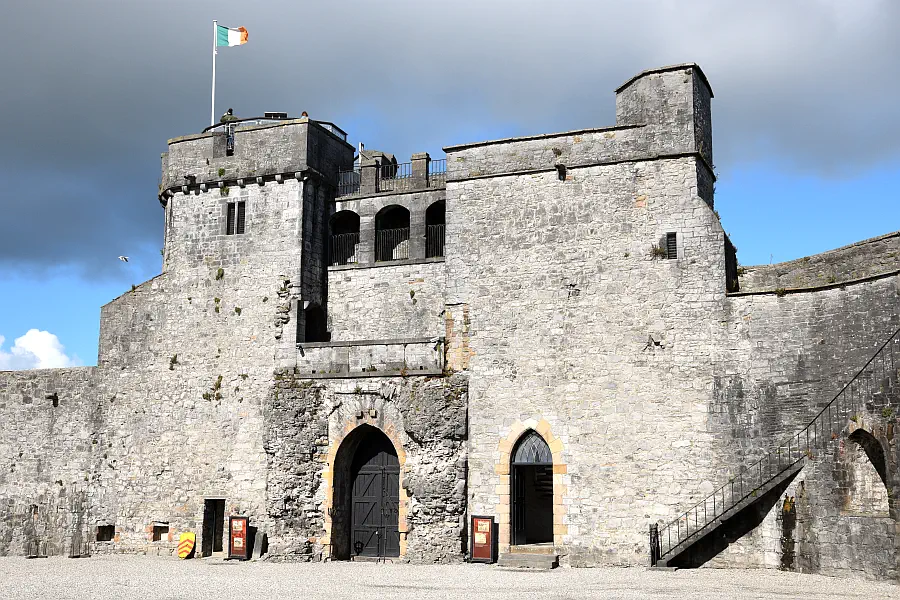
Image by Greg Mansfield
Location: Nicholas St, Englishtown, Limerick
Open: Daily, 9:30am to 5:30pm
Admission Fee: Yes
Parking: Pay parking lot nearby
Website: kingjohnscastle.ie
Standing guard over the River Shannon for more than 800 years, King John’s Castle dominates Limerick City’s skyline. This medieval fortress tells a tale of Viking warriors, brutal sieges, and lingering ghosts.
Long before King John of England ever set foot in Ireland, Vikings claimed this ground. In 922, sea-king Tomrair mac Ailchi chose this place as his stronghold, recognizing its strategic value on the Shannon.
The medieval castle was built between 1200 and 1212. King John ordered its construction after his Anglo-Norman forces seized control of the region. He picked this spot for a reason: Limerick needed protection from Gaelic kingdoms pushing in from the west and rebellious Norman lords threatening from the east. To show off the city’s growing wealth, King John set up a Royal Mint in the castle’s northwest corner.
Peace never lasted long at King John’s Castle. The fortress suffered five separate sieges during the 1600s alone. The worst came in 1642, when Irish Confederate forces surrounded its walls. Without proper siege weapons, they had to tunnel underneath and collapse sections of the fortification. The damage was so severe that the defenders had no choice but to surrender.
Each battle left its mark—not just on the stones, but on the very atmosphere of the place. With such a violent past, ghost stories cling to King John’s Castle like moss on ancient stone.
The most famous ghost is known as “The Black Lady.” Witnesses describe her as strikingly beautiful, with long blonde hair flowing behind her as she paces along an open-air passage in the northeastern tower. She wears elegant robes and appears most often at dusk during summer evenings.
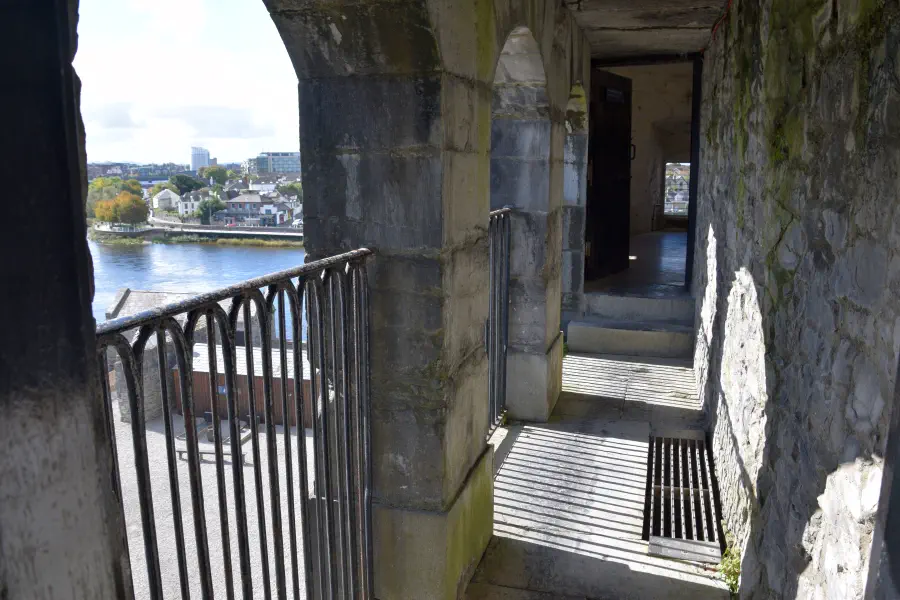
Image by Greg Mansfield
Then there’s the Medieval Guard. This phantom soldier still mans his post at the gatehouse entrance, centuries after his death. On moonlit nights, visitors spot him in full armour.
The hauntings go beyond apparitions. Doors slam shut on their own. Strange lights and glowing orbs appear without explanation. Most unsettling are the sounds of heavy footsteps marching in empty corridors, armour clattering against stone, and the metallic ring of sword against sword. It’s as if the castle’s bloodiest battles keep replaying, trapped in an endless loop.
Paranormal investigators have documented these phenomena. During one filmed investigation in the tower, equipment captured what researchers described as a “visceral thud”—physical proof that something unexplained is happening here.
For the best view of King John’s Castle, head to Thomond Bridge. But watch your step, especially after dark. Local legend warns of the “Limerick Banshee” haunting this area. Many believe she’s the ghost of a despised bishop’s wife, drowned in the Shannon by angry townsfolk. She lurks near the bridge, trying to drag late-night wanderers into the river’s dark, rushing waters.
Leamaneh Castle
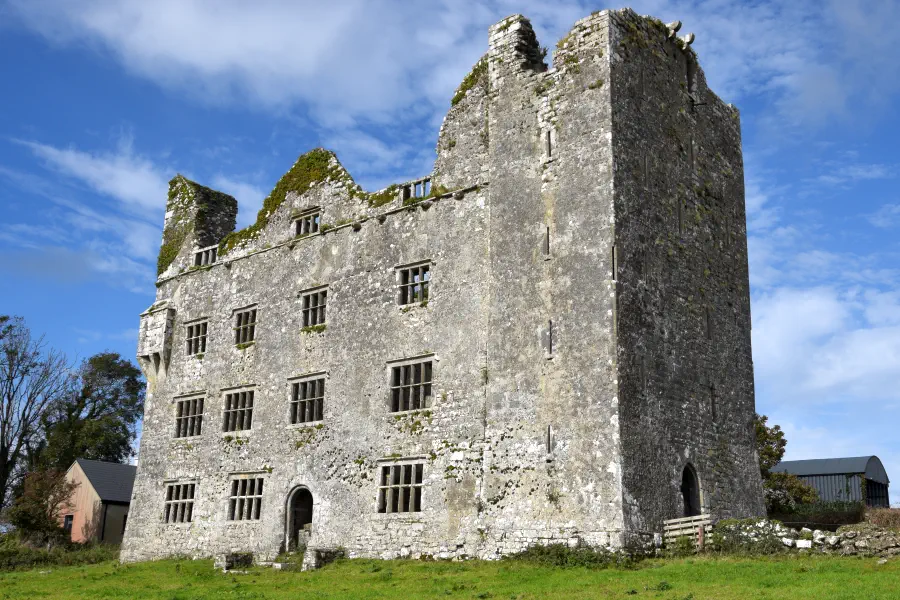
Image by Greg Mansfield
Location: Leamaneh North, between the villages of Corofin and Kilfenora, County Clare
Open: Closed; private property, please don’t trespass
Admission Fee: N/A
Parking: On the road nearby
Website: N/A
In County Clare’s rugged Burren landscape, a crumbling stone fortress cuts a dramatic sight against the sky. This is Leamaneh Castle, and its weathered walls are the setting of one of Ireland’s most chilling legends.
The castle stands near a crossroads, and its name is linked to part of the dark legend that grew up around it. “Leamaneh” comes from the Irish phrase léim an éich, meaning “the horse’s leap.”
Leamaneh isn’t just one building—it’s actually two structures from different centuries merged together. The original tower stands five stories tall. Built between 1480 and 1490, this tower house was the work of Toirdhealbhach Donn Ó Briain. His bloodline traced directly back to Brian Boru, one of Ireland’s last High Kings.
In 1648, Conor O’Brien and his wife Máire Nic Mhathúna MacMahon added a grand four-story manor house to the tower. While Conor commissioned the expansion, his wife would become the castle’s most infamous resident. Máire earned a nickname that still echoes through Irish folklore: Máire Rua, or “Red Mary.” Her flame-colored hair matched her fiery temperament, and what happened next would tarnish her reputation for centuries.
In 1651, English forces mortally wounded Conor in battle. Most widows would have mourned, but Red Mary rode straight to Limerick. She found a Cromwellian officer named Cornet John Cooper and offered him marriage on the spot. He agreed, and this coldly calculated move saved the family’s vast estate from English seizure. The O’Brien lands stayed in the family.
By 1684, Red Mary’s son, Sir Donat O’Brien, moved the family to a new home at Dromoland Castle. Without the family in residence, Leamaneh slowly crumbled into ruin. By the late 1700s, it was completely abandoned.
If Red Mary’s story ended there, she’d be remembered as a shrewd tactician. Instead, folklore transformed her into a monster. According to legend, she would execute male servants by hanging them by their necks. Supposedly, female servants also met a horrible fate—hanged by their hair.
The stories grew even darker. People whispered that Red Mary married 25 times, disposing of unwanted husbands through brutal means. She allegedly kicked some out of the castle’s high windows. Others simply disappeared.
One legend stands out above the rest: Red Mary supposedly trained a wild stallion for murder. She would force victims onto the horse, which would then gallop straight toward the Cliffs of Moher. The rider would be thrown to their death on the rocks below. That phrase—”the horse’s leap”—takes on a new and fantastical meaning.
Historical records suggest Máire Rua died peacefully around 1686, probably at Dromoland Castle. She was likely in her bed, surrounded by family. But folklore tells a different story. According to legend, her enemies finally caught up with her. They shackled her inside a hollow tree and left her to starve to death.
Which version is true? The peaceful death seems more likely. But the violent ending fits the legend better, and legends have a way of outlasting facts.
Today, Leamaneh Castle sits on private land. You can’t walk through its crumbling rooms. But even from a distance, visitors report strange phenomena. A red-haired woman appears among the ruins. She drifts through doorways that no longer have doors and glides past windows that are open to the elements.
When storms roll across the Burren, people hear screams echoing from the vast, empty structure. Sometimes the screams give way to wild, unsettling laughter.
The sightings extend beyond the castle itself. At the nearby Druid’s Altar, or Poulnabrone Dolmen, witnesses claim to see the same phantom figure. And on dark roads around Leamaneh, drivers report seeing a horse and rider racing past at impossible speeds—forever reenacting that deadly ride to the cliffs.
Was Red Mary really a serial killer? Probably not. Most historians believe the tales were exaggerated over time, mixing fact with fiction until the two became impossible to separate. But something about her story captures the imagination. Perhaps it’s the image of a calculating woman wielding power in a male-dominated world. Maybe it’s the contrast between her strategic brilliance and alleged cruelty. Or it could be the castle itself—a perfect setting for a horror story.
Whatever the truth is, Red Mary refuses to be forgotten. Her story has survived over 300 years and shows no signs of fading. The castle may be a ruin, but the legend is as strong as ever.
Recommended
Books